New Low-Waste Method Breaks Down Tough-to-Recycle Plastics
The method could help create plastic products with the best of both worlds by combining durability with an eco-friendly life cycle.
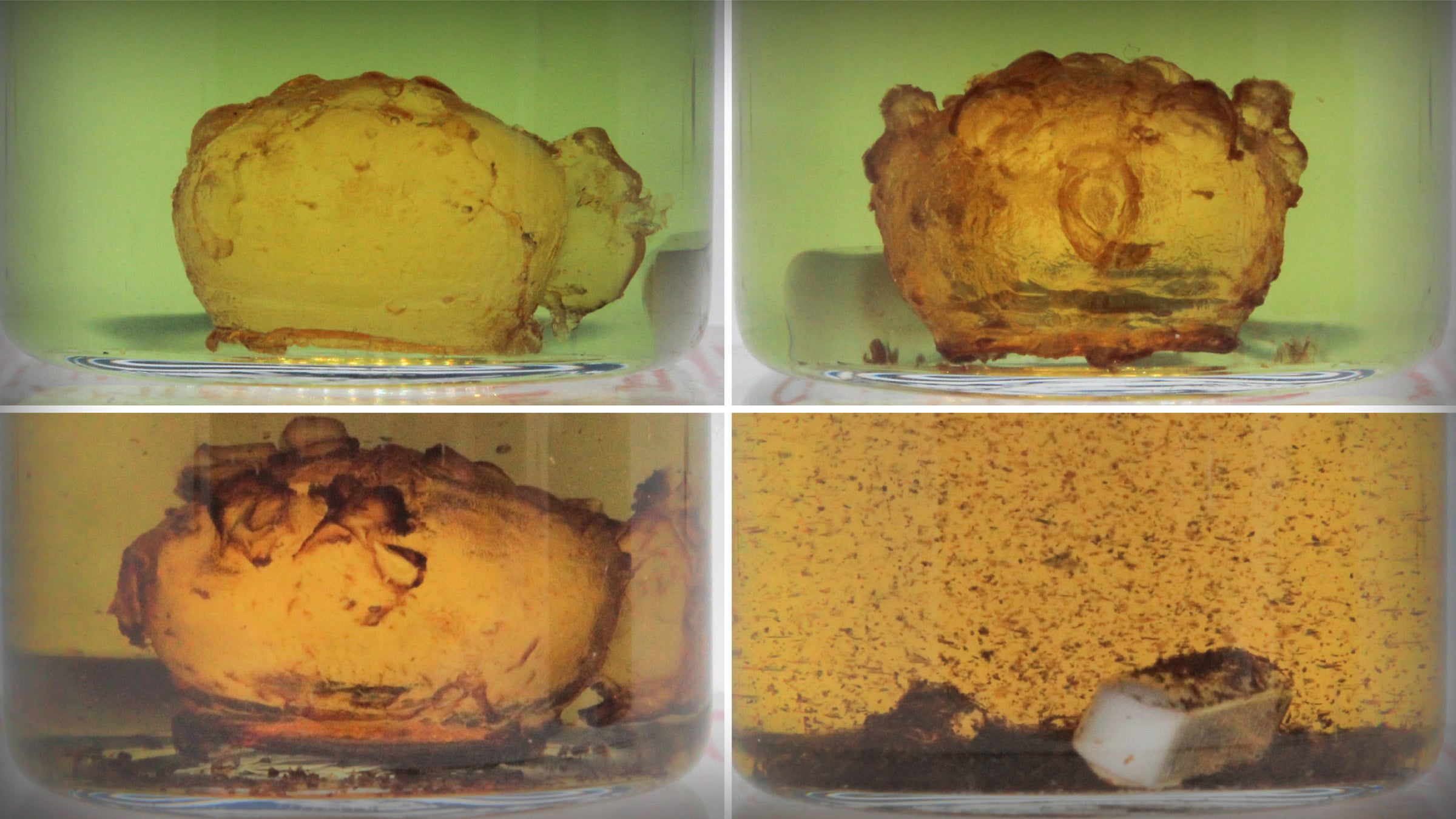
A 3D-printed pufferfish made of pDCPD undergoes deconstruction in a solution containing an eco-friendly solvent and ruthenium-based catalyst. Credit: University of Texas at Austin.
A new recycling technique could help tackle a major challenge: breaking down some of the toughest plastics without generating large amounts of waste.
A team led by researchers from The University of Texas at Austin and Sandia National Laboratories has developed a simple method for breaking down durable plastics that currently have no practical recycling method. This approach uses less energy and produces less waste than incineration, while allowing for the full recovery of valuable fibers. The team published its results in the journal Science Advances.
When manufacturers need a plastic that is both durable and lightweight, they often turn to poly(dicyclopentadiene), or pDCPD. The material is used in products ranging from vehicle bumpers and construction equipment to chemical storage tanks. But products made with pDCPD are extremely difficult to recycle and are instead often incinerated, which requires much energy, produces harmful byproducts, and degrades fibers blended in for reinforcement.
“Before now, people might have avoided using these materials, despite their strength, durability and lightness, because they didn’t have a good way to recycle them,” said Zak Page, a UT associate professor of chemistry and corresponding author on the paper. “Switching to pDCPD might mean the same product can perform better, while also having a longer lifespan before it needs to be recycled. I hope this will encourage more people to consider using pDCPDs.”
The research was primarily funded by the U.S. Department of Energy, with additional support from the Robert A. Welch Foundation, the Alfred P. Sloan Foundation, and the Arnold and Mabel Beckman Foundation.
To dissolve an object made of pDCPD with this new method, the researchers placed it in a solution that included an eco-friendly solvent and a catalyst containing ruthenium. The object was then stirred for periods ranging from hours to days, depending on its size. In a process that looks like a sugar lump dissolving in water, the plastic deconstructs and dissolves in the solution, leaving behind a powder that can be reused in new plastics. Any fibers, such as carbon or glass, that were added to pDCPD can also be isolated in pristine form and reused in new materials.
One of the biggest remaining questions is whether the ruthenium catalyst can be recovered and reused, making the overall process more sustainable and affordable.
The breakthrough originated from an unexpected result. While working on a new method to produce pDCPD plastics, UT Austin graduate student Keldy Mason exposed the material to a solution containing a solvent and catalyst that was meant to make it more durable. Rather than strengthening the plastic, the process broke it down, dissolving the material.
“This type of material has been around a long time, and the wisdom was that it was just too thermodynamically stable for this reaction to go the other way,” Page said. “So, this was quite a surprise.”
There are many types of plastics used in everyday life. This new method could eventually enable a circular lifecycle for pDCPDs, similar to advances made in recent years by UT researchers that could help address even more widely used types of plastics, such as those in water bottles and disposable bags and wrappers.
UT, Sandia National Laboratories and four study authors have applied for a U.S. patent related to the technology.
Co-first authors were Keldy Mason, Meghan Kiker and Zhenchuang Xu. Researchers from the University of Illinois Urbana-Champaign and the Massachusetts Institute of Technology also contributed.